
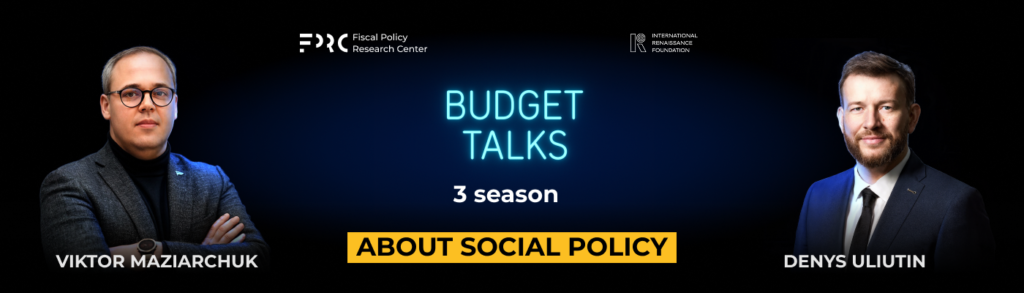
The first episode of Season III of Budget Talks focuses on social policy during wartime. Why does the old system of “benefits based on status” no longer work? Is society ready to abandon the principle of “a little for everyone”? Why has the prosthetics system reached the “ceiling” of its capabilities? And what does the strategy for internally displaced persons (IDPs) include?
In the new episode of the podcast Budget Talks, we address these and other pressing questions. Viktor Maziarchuk, Head of the Fiscal Policy Research Center, and Denys Uliutin, Minister of Social Policy, Family and Unity of Ukraine, discuss whether the state can guarantee social justice under conditions of limited resources and how this can be achieved.
VIKTOR
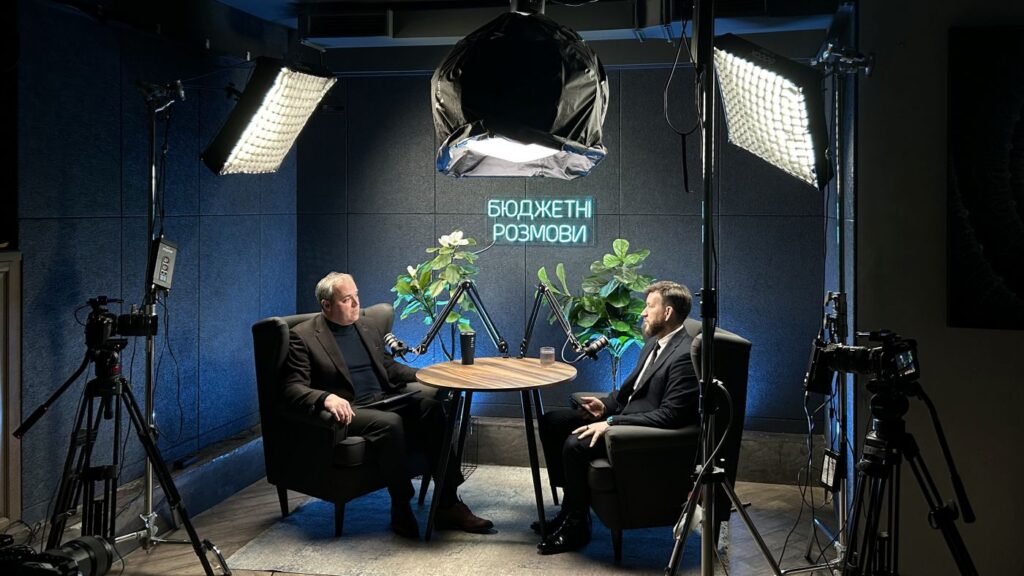
Good afternoon, dear viewers and listeners. We are recording the first podcast of the third season, and I have the honor of welcoming to the studio the Minister of Social Policy, Family and Unity of Ukraine, Denys Uliutin. Today we will talk about social policy, about internally displaced persons, and about the complex – very complex – issues that you are currently responsible for and working to resolve.
Welcome, Denys. I’m very glad to see you, and thank you for finding time in your busy schedule.
DENYS
Good evening. Thank you for the invitation. Indeed, the social sphere is quite complex, with many issues – and most importantly, every issue concerns people’s lives.
On Ukraine’s Second-Largest Budget After Defense
VIKTOR
470 billion hryvnias – this is your budget. It is larger than last year’s, and considering possible additional payments, you have one of the largest budgets in modern Ukrainian history. What are your priorities? And what goals are you setting for yourself?
DENYS
In fact, the social budget is the second largest in Ukraine after defense spending. And that says a lot. First of all, it shows that the social sector remains a priority for the state even in the conditions of full-scale aggression. Second, it indicates that there are many issues in the social sphere that need to be addressed. These include pension provision, support for internally displaced persons, prosthetics, and many other areas – including support for families with children and enabling parents to combine family responsibilities with work and economic activity. All these areas are extremely important, and they are at the top of the agenda. The budget itself reflects this.
At one time, you and I talked a lot about what the social sector should look like and how resources should be used efficiently – resources that, essentially, taxpayers channel through the budget to support other citizens. And this is precisely the answer to your question about what matters most to me. First, it is important that we do not lose the social focus in terms of effectiveness. And second, that we actually achieve efficiency. Efficiency in helping those in the social sector who genuinely need it. We need to move away from a status-oriented social system, where payments for a long time were provided solely on the basis of status, and transition toward assessing needs and providing payments or support in accordance with those needs. That is exactly what we are working on now. This is the approach we are trying to build within the ministry.
VIKTOR
Could you elaborate on this a bit more? Because, in fact, it is interesting. Behind what sound like very simple words – “changing status,” “priorities,” “efficiency” – there is probably much deeper work that may ultimately lead to changes in people’s lives.
“We have rethought the social sector as a whole”
DENYS
First of all, what have we done? We have rethought the social sector and social policy as a whole. For us, it is important that the social sphere – or social policy – does not remain a policy of minimal support extended over a long period of time. And again, if we speak about statuses, this is an old system – long-standing, quite rigid, and difficult to abandon. A system in which we pay small amounts of money.
I have already said that this is not, for example, a question for the Minister of Social Policy alone, or for any individual minister, or even for members of parliament. It is a question for our entire society: are we ready to move in this direction or not? In reality, there is quite a substantive debate taking place. Since there is no such thing as “state money” – there is only taxpayers’ money – we must decide whether taxpayers are ready to pay for such a scope of commitments and whether they are able to pay for it.
And when we begin to frame the question in this way, I believe we will be able to move toward a model based on several principles: first, an assessment of needs; second, short-term supportive payments; third, social services; and the necessary infrastructure for those services. This is a normal, widely recognized model for building social policy. The alternative model is one of minimal payments, where the state essentially pays off certain groups with small amounts simply because it has to.
Who Benefited the Most in 2026
VIKTOR
If we look at all social services, who benefited the most in 2026? Which groups receive the largest payments, or larger payments than last year?
DENYS
Even the question itself – “which groups”?
VIKTOR
For example, the birth payment – 50,000 hryvnias.
DENYS
Previously it was 42,800 hryvnias. But it was distributed over three years, whereas now we pay it as a one-time payment. Overall, this payment is provided under the law on combining parenthood with work. It was primarily targeted at addressing the challenges families face when a child is born. We reviewed analytics conducted by UNICEF regarding how families with children tend toward vulnerability compared with those without children. The difference is twofold. In other words, if a family has a child, it is much more likely to become vulnerable.
VIKTOR
Could you please explain what you mean by “tends toward vulnerability”?
DENYS
About 20% of families without children may fall into vulnerability under certain circumstances. If there are children in the household, that figure rises to 48%. Therefore, we understand that the first priority is to support families during the first year after a child is born, which is the most difficult period. The payment for the first year is currently set at 7,000 hryvnias, and it will be determined by the annual budget law. The second component is to encourage parents to return to work after the first year. We understand the challenges families face when a mother returns to work: where to leave the child, how to arrange childcare, and the related expenses. Therefore, assistance of 8,000 hryvnias has been introduced for the period up to the child reaching three years of age. This will also be determined by the budget law of the relevant year. The aim is to create opportunities for a mother, father, or legal guardian who returns to work to leave the child in a daycare facility or pay for a nanny. This is how we are building the overall structure. First, we assess the need. After assessing the need, we determine what is required. We concluded that a one-time payment for initial recovery and preparation should be 50,000 hryvnias. This includes the Baby Box – a basic set of items necessary for the birth of a child. Then we consider what the family needs next. We evaluated that need and designed the payment accordingly.
The next component is services – care services and other services that will also be developed at the community level. For example, nanny services will emerge as a supply only when there is sufficient demand. Right now, we are creating that demand. At the same time, we are giving mothers, fathers, or legal guardians the opportunity to return to work without losing opportunities for career growth and personal development – something families often struggle with after the birth of a child. This is not an emotional policy approach from our side. It is purely a structured economic model combined with research that we studied beforehand in order to address this issue properly. We understand that there are still many other needs, and we are currently working on them within the ministry. This was a justified and carefully considered decision. There are also other directions.
VIKTOR
For example, what other directions?
DENYS
At the moment we have been actively rethinking policy toward internally displaced persons. Recently, responsibility for IDP policy was transferred to the Ministry of Social Policy. As things stand today, the system is truly fragmented. The process – from evacuation to integration – is broken. The pathway is disrupted, and all these measures are often limited to reactive payments at a specific moment in time. For example, a person evacuates and arrives at a transit center. There, they receive cash assistance provided by international partners – 10,400 hryvnias. Then they travel wherever they manage to go. In other words, the process is disconnected. People are given assistance and placed in temporary accommodation centers (TACs), which in theory should provide a short adaptation period of 6 to 12 months. In reality, however, they become places of long-term residence. People have been living there since 2022, and some even since 2014–2015, since the beginning of Russia’s aggression. This break in the process is exactly the problem. We want to change this. Evacuation to a transit center is important, although perhaps the focus should instead be on directly financing the evacuation itself. We are currently working on this through the Ministry of Social Policy’s humanitarian account, using the entire chain of public finance mechanisms – the banking system and the treasury system – to simply fund the evacuation.
Next comes placement in temporary accommodation, with an adaptation period. At that stage, adaptation services must be provided. A needs assessment should also take place – possibly even before arrival at the temporary accommodation center. For example, last year we realized this in Pavlohrad. We visited a temporary accommodation facility and saw that elderly people being evacuated should not move directly from the transit center to temporary accommodation. Instead, they should first go to a medical institution. As a result, we introduced a nursing care service. Now a person can spend up to two months in a healthcare facility to restore their health and undergo necessary examinations. Many of these people have lived under prolonged stress in frontline areas. They may have had poor nutrition or lacked access to healthcare. So the first stage is stabilization and evacuation.
Then comes temporary accommodation with adaptation services and short-term payments. After that, people are integrated: if they are of working age, they are offered training or employment opportunities; if not, they may move to supported living arrangements where they remain active, have leisure opportunities, and have their own space. Alternatively, they may receive a stable housing solution, which we are currently developing together with colleagues. In this way, they are integrated into society. The process is no longer fragmented or unfinished, where someone remains in temporary accommodation without knowing what will happen next.
VIKTOR
Is the state today capable of guaranteeing social justice, especially when resources are limited?
DENYS
First, we need to understand what justice means in this context. For me, justice means that the state does not abandon people in hardship and does not allow those who are truly at risk to fall into vulnerability. Let me illustrate how I imagine an ideal social state functioning – based on case management and needs assessment. Consider a hypothetical example. A person comes to an employment center because they have lost their job. What should the state do at that moment? Ideally, it should understand the person’s needs – not only employment but all their needs. Does the person have young children? Elderly dependents? People with disabilities in the household? Or, God forbid, children with disabilities? In other words, the state must assess the needs of the entire family at the moment when a person loses their job. In fact, the state should intervene even earlier – not when the person arrives at the employment center, but when the state becomes aware that the job has been lost. Because the person may immediately need assistance – for example, temporary support for children.
If we fail to intervene at the starting point – point A, when the job is lost – then by the time the person eventually reaches the system through some other channel, the situation will already have deteriorated. Perhaps the children are not getting enough food and a report is made to the child protection service. Or, God forbid, one of the children becomes ill, which triggers a signal through the Ministry of Health. At that stage the response becomes reactive, and the state becomes a very ineffective manager because additional mechanisms are triggered…
VIKTOR
…quick decisions, perhaps.
DENYS
Not even quick – they are harsh. Children have to be removed from the family. But perhaps the right intervention should have happened at point A, when the mother lost her job, when she was alone and simply did not know what to do, when she was experiencing depression or something similar. What should we do as a state? That is where we should intervene. That is where our work should be focused. Instead of simply saying: you lost your job – here is unemployment assistance. It is small, you will not be able to live on it, your children will not have enough to eat, but that is supposedly not our concern. We paid, after all. We did not assess the need beforehand; we simply paid. Here is a small benefit – this is all we can afford, we do not have more money. But the fact that we used the resources inefficiently and did not conduct proper analysis is a much larger issue. As we said at the beginning of this discussion, the budget – 476 billion hryvnias – is a very, very large budget. Again, the system is rigid. Telling someone that tomorrow they will no longer receive 2,000 hryvnias – simply because it does not actually help them, while someone else truly needs that money more and we would redirect it there – would probably be the biggest challenge.
VIKTOR
And a provocation that various Telegram channels would immediately pick up tomorrow and start stirring controversy…
DENYS
In fact, the most important point is to understand that social support cannot be permanent. We must clearly state that if a payment is temporary, then it must remain temporary – it cannot be extended year after year.
What the Strategy for Internally Displaced Persons Envisions
VIKTOR
Four and a half million internally displaced persons – a huge number of people with difficult personal stories. Today there are dozens of different programs, decisions, and exceptions. You began to say that you are trying to bring together fragmented processes and broken chains. Can we say that the state already has a strategy regarding IDPs? Or are we still trying to solve the problem in a fragmented way, gradually moving toward a strategic vision of what to do with these people?
DENYS
We have completed drafting the IDP strategy. I think we will soon submit it for interagency coordination. In this strategy we tried to describe the entire pathway – from evacuation to integration within communities. Moreover, we added a section on the return of citizens from abroad. We did not create a separate return strategy but included a large block within the IDP strategy itself. Again, our vision is to avoid separation and to prevent tension between internally displaced persons and those who will be returning from abroad. This is very important. In addition, we tried to structure the entire pathway and included elements such as preliminary evacuation requests. In parallel with the IDP strategy, we understand that its implementation requires an IT component. We are also developing a web resource called 123, which will provide step-by-step guidance. It will include self-declaration for evacuation, a list of temporary accommodation centers where people can stay for a period of time, and a reintegration section covering everything related to employment and housing.
This is important for us because civil society organizations currently evacuate people only when the situation has already become extremely dangerous. We want to create the possibility for people to register themselves in advance so that evacuation can take place before the situation escalates. Of course, this is also difficult because people tend to stay as long as possible. We structured all of this in the strategy step by step, defining what we want to achieve: the evacuation stage, the adaptation stage, and the integration or reintegration stage within new communities. We must also involve host communities, which should be interested in creating jobs. For example, one realization for me was that the greatest demand among IDPs is housing. Perhaps all the other programs designed for them should be reduced, leaving one major housing program. And we should focus on implementing housing solutions. Not ownership, because I understand that property restitution will be a matter of reparations when compensation for lost property becomes possible. But there must be some kind of solution that provides people with housing – something other than temporary accommodation centers. This is exactly what we are working on now.
VIKTOR
So theoretically we can expect that certain solutions may appear in the strategy by the time it is adopted?
DENYS
The strategy provides a strategic framework. The specific implementation decisions will come afterward. Stable housing solutions must be developed. Without them, we will remain stuck at the stage of temporary accommodation centers.
Why the Prosthetics System Has Reached a “Ceiling”
VIKTOR
Then the problem will not be solved at all. Another major challenge you face – and one that the war has exposed – is prosthetics. Your ministry is responsible for this area. Unfortunately, tens of thousands of people require prosthetics as a result of the war. Many complain that obtaining a prosthesis is difficult and expensive. What is the ministry doing in this direction? And more broadly, what is your vision for this issue? Where should we be heading?
DENYS
This is a very broad question that could easily become a separate podcast. The issue is that it was one of the first major tasks facing the ministry, because the prosthetics system today is indeed quite fragmented. We convened a large working group that included representatives of civil society organizations, ministries, manufacturers, users, and both participants and non-participants in state programs. The purpose was to discuss what kind of prosthetics system we want to have. Our statistics show that we have reached a ceiling. We are able to provide prosthetics for about 11,000 people per year.
VIKTOR
Do you mean a ceiling in production capacity?
DENYS
A ceiling for the entire system. Without serious decisions and major changes, we will not break through that ceiling. I looked at statistics from the last three years – 11,000 is the limit. And this is not the number of people who, unfortunately, have amputations as a result of armed aggression or other circumstances. The problem is that we simply cannot do more. This concerns training, the number of specialists, the patient pathway, early rehabilitation, post-rehabilitation, and pricing. We described all of this in a roadmap titled Reforming the Prosthetics System. We have already submitted it to the Cabinet of Ministers of Ukraine [the national executive government]. There was an extremely broad discussion – heated, in fact – because everyone has their own vision of what the ideal system should look like. Thank God everyone shares the desire to make this system as effective and as people-centered as possible – for both civilians and military personnel. For us, the key outcome of this work must be the return of a person to life, including economic activity.
VIKTOR
Tell me, will eight billion hryvnias be enough for this?
DENYS
Yes. And regarding the claim that it is impossible to obtain a prosthesis – the state fully covers high-function prosthetics for all wounded military personnel. Moreover, last year we simplified access to sports prosthetics for service members, increased prosthetics funding for civilians, and simplified the process for children. In other words, we have taken many steps to make the system more people-centered. We see real-life examples showing that high-quality prosthetics, high-quality rehabilitation, and timely rehabilitation lead to incredible results. People return to economic life. Some ride motorcycles even after triple amputations – it is extraordinary. These individuals can and should be involved in economic activity, because they think differently. They are more structured and goal-oriented. Such people should be included in all teams.
VIKTOR
I can confirm your point because my colleague has a double amputation and lives a full life – of course with certain limitations – but he remains an active part of society.
DENYS
These are incredibly motivated people. And I want to correct something here: it is society that must integrate, not them. They should not have to integrate into society.
VIKTOR
Society must change its perception.
DENYS
Society simply has to change. It is society’s responsibility to change. This is an extremely important element. I remember when we were in Lviv – there was a serviceman with a quadruple amputation who drives a car and motivates others by saying that this is only the beginning of a new stage of life. In general, everyone I speak with who has received prosthetics is highly motivated to live their best life. Truly motivated. They do not want to remain isolated in their homes. They want to be – and already are – active participants in society. They drive society forward. In reality, society sometimes moves like jelly, but these people push it forward and show the direction. They are so motivated that after speaking with them, you return to your work thinking: there is still a lot to do, and we can do it.
VIKTOR
And you leave energized, continuing to chip away at that rock.
DENYS
Of course. Not only me – my entire team.
On Salaries of Social Workers
VIKTOR
That is understandable. Social workers: since January 1, their salaries have increased by 2.5 times. A social manager who previously earned 8,000 hryvnias now earns 20,000, and a social work specialist who earned 6,800 now earns almost 17,000 hryvnias. Do you expect that higher salaries will attract more professionals to this field? And will it mean that people receiving these services will receive them with higher quality? In other words, will the state be able to provide better services to those who need them?
DENYS
I would not say that people will immediately rush to join the social service sector. The first step is to stop the outflow of personnel. In reality, there are many highly qualified professionals in the social system who work with real dedication, almost on a volunteer basis. We must understand that they are the first to encounter people in difficult life circumstances – people facing vulnerability. If they earn 6,800 hryvnias, we have to ask how effectively they can help others. The first step is to help the social system itself. If you cannot help yourself, you cannot help others. It is like the oxygen mask on an airplane – you put it on yourself first so that you can help someone else afterward. The same principle applies here.
We also have something to compare with. Our Resilience Centers, which are being developed by the Ministry of Social Policy, operate under a different compensation system. If you visit these centers, you see the difference in the level of social services provided and how they can be delivered. They demonstrate best practices in providing social services. Social workers there receive salaries at the level of average market wages, and the difference is clearly visible. Increasing salaries was not even a question of social expediency – it was a matter of economic expediency. When you provide a high-quality social service and identify a problem early, you prevent that problem from escalating in the future. Because when a social worker is properly paid, they are able to fully dedicate themselves to their work. That was the primary reason for the decision. It is an extremely difficult job – there is really nothing comparable to it.
VIKTOR
First of all, emotionally, as I understand it. Every day people encounter the problems of others that they must address on behalf of the state.
DENYS
Even during regional visits, you see it. Their request was not a demand. I have seen many situations where salary increases were demanded. In this case it was simply a request. And when you see how much they work and how heavy the workload is, you realize that a salary at least at the level of the average wage is a necessity under these conditions.
“Cutting Spending” vs “Asking for Money”
VIKTOR
We started by mentioning your extensive experience as First Deputy Minister of Finance – five years in that role. And now you have been heading the Ministry of Social Policy for six months…
DENYS
How should I put it? It is like moving from the first stage of marriage to the second. The first stage is the honeymoon, and the second is…
VIKTOR
…reality.
DENYS
Yes, reality – when the rose-colored glasses begin to come off. At least for now, this feels like the second stage.
VIKTOR
What does it feel like when previously you were the one who had to cut spending and say “no”? To get approval from Uliutin back then, one really had to try hard, because you were one of the pillars in the ministry who would say “no,” and you did so with solid arguments. Earlier you were the one rejecting proposals and cutting expenditures; now you are the one asking for funding. How has that mindset changed? What does it feel like?
DENYS
We can ask just as convincingly as we used to say no. The difference is that now we also add arguments showing that these particular expenditures are economically justified for the state.
VIKTOR
Does that help?
DENYS
More or less. We understand each other when speaking with my colleagues. I understand that they are also managing not their own money but taxpayers’ money. They want efficiency just as much as we do. In many cases we reach positive and high-quality decisions. For example, when you work in the Ministry of Social Policy, it can be difficult to see the other side – the side of financial efficiency. Emotions inevitably play a role because you interact with people and their problems. Naturally, at times those emotions can overwhelm you. That is why it is important that someone else can look at the situation from another perspective. I see this as a very interesting stage. It is also very good that this comes after my time in the Ministry of Finance, because it allows you to look at social policy from another angle – not only from the perspective of social considerations but also from the perspective of efficiency.
VIKTOR
So am I right in understanding that communication between the Ministry of Finance and the Ministry of Social Policy is now much easier when it comes to finding compromises to solve problems?
DENYS
I would not say it is easier. It is always difficult to negotiate with the Ministry of Finance.
VIKTOR
You were on that side, so you understand.
DENYS
Exactly. I know how difficult it can be. But in any case, you can build arguments. You can show your understanding of the Ministry of Finance, of how its decision-making model works, and what exactly is required to secure certain resources. For example, when we discussed how much funding would be required to implement the law on combining parenthood, motherhood, and work with economic activity, we conducted statistical sampling and calculations. We estimated how many people could potentially return to work and what percentage would want to do so. These were quite complex discussions.
The Most Difficult Decision as Minister
VIKTOR
You are responsible for the social policy affecting millions of Ukrainians at a very difficult time, when needs exceed available resources – we touched on that earlier. What helps you avoid losing motivation? Is there a particular moment or story that inspires you?
DENYS
There are many such stories. But the greatest energy you gain in this ministry comes from traveling to the regions, especially those near the frontline. It is incredibly motivating. I remember visiting Zaporizhzhia region, where we opened an underground school. You could feel the energy of the children who came there. The existence of an underground school achieves two things. First, it provides a safe place for children to learn and interact even during the war. Second, it supports the region’s economic development, because parents know their children are safe and can work effectively. Moreover, when you visit such schools, you see the energy in the children’s eyes – many of them are attending school for the first time in their lives. There were children there who had literally never been to school before.
VIKTOR
COVID, the war…
DENYS
Exactly. They had never experienced it before. Now they communicate, they begin to interact with each other. They are so full of energy that they could practically generate electricity for the grid. And that is amazing. Or when you visit prosthetics centers and see how motivated people with amputations are to live and to continue improving this country – you realize that you are exactly where you should be, at the time when you should be there. There may not be a better moment in your life to do what you have been preparing for for so many years – to do something truly better.
VIKTOR
What has been the most difficult decision you have had to make as minister?
DENYS
I think the most difficult one has not happened yet. It is still ahead.
VIKTOR
Denys Valeriiovych, thank you for your time and for this conversation. It was difficult to take you away from your very busy schedule to discuss social policy in this podcast. I hope that today, thanks to you, people have learned more about what the state is doing to address the difficult situations they face. I would also like to thank the defenders of Ukraine for giving us the opportunity to breathe freely in a free country.
DENYS
Thank you for the invitation. Thank you for focusing attention on these issues. And thank you to the defenders of Ukraine for allowing us to think strategically, plan, and build the future.
VIKTOR
Colleagues, subscribe, leave likes, comments, and questions for the minister.
DENYS
Absolutely.