
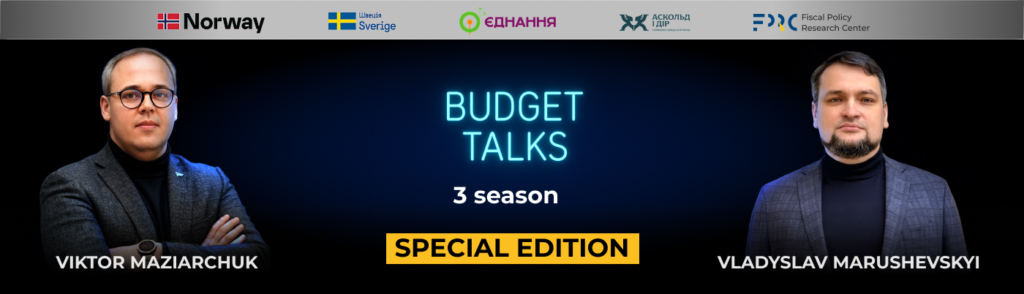
A special episode of Season III of “Budget Talks” – about the Ukraine Facility. How does Ukraine monitor the use of billions of euros in assistance from the European Union? What role does the State Audit Service of Ukraine (the central government body responsible for public financial control and auditing) play in this process? And why does financial oversight directly influence the trust of international partners?
In the new episode of the “Budget Talks” podcast, we address these and other pressing questions. Viktor Maziarchuk, Head of the Fiscal Policy Research Center, and Vladyslav Marushevskyi, Deputy Head of the State Audit Service of Ukraine, discuss how the system of oversight over European funds operates in Ukraine and what has changed with the launch of the Ukraine Facility.
VIKTOR
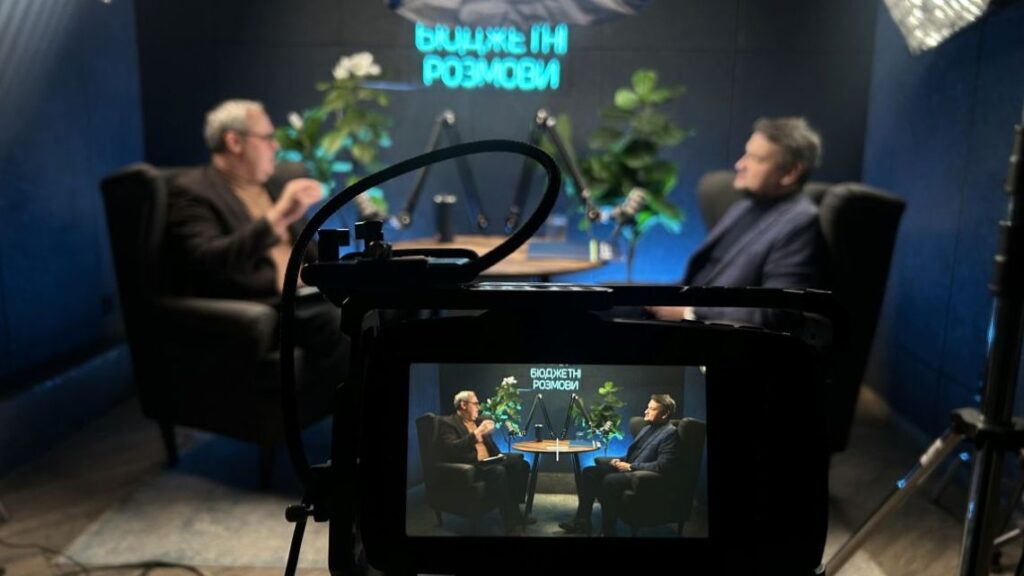
Welcome to the “Budget Talks” podcast by the Fiscal Policy Research Center. This is a space where we speak simply, honestly, and openly about public finance and everything related to money. This is a special episode of the podcast created with the support of the Askold and Dir Foundation, administered by ISAR Ednannia (Initiative Center to Support Social Action) within the project “A Strong Civil Society of Ukraine – a Driver of Reforms and Democracy,” funded by Norway and Sweden. Today’s special episode is about European integration, oversight of funds provided by our European partners, and, most importantly, about trust in Ukraine. Our guest today is Vladyslav Marushevskyi, Deputy Head of the State Audit Service of Ukraine, and accordingly one of the country’s leading public financial auditors. First of all, welcome, and thank you very much for the opportunity to speak about the work you are doing.
VLADYSLAV
Thank you. It is an honor for me to be here. I had the opportunity to watch some of the previous episodes and guests, and I am glad to have the chance to answer questions alongside such strong and respected people, to talk, to explain, and even more importantly to inform the audience about what the State Audit Service actually does.
Who Protects the EU’s Financial Interests in Ukraine
VIKTOR
The State Audit Service is effectively the key controller overseeing the use of €50 billion in macro-financial assistance from our partner, the European Union. Could you explain what the overall role of the State Audit Service of Ukraine (the central government body responsible for public financial control and auditing) is in the European integration process? What do your partners expect from you? And what do they expect from you specifically under the Ukraine Facility?
VLADYSLAV
The expectations are actually very high. They stem from the European Union’s overall level of attention to Ukraine. To provide some context, I would like to mention a few figures. Before 2014, assistance to Ukraine was measured in millions of euros. Roughly speaking, the annual support did not exceed about €140 million per year. After 2014, the volume of assistance increased, but it still amounted to around €17 billion for the entire period from 2014 to 2022. Of this amount, €9.5 billion were loans that had to be repaid. Since 2022, however, the scale of support has changed dramatically. Funding from the European Union alone has reached €193.3 billion. In addition, another €90 billion has been approved – quite recently the European Parliament voted to provide Ukraine with €30 billion for the state budget and €60 billion for military assistance. How exactly these funds will be used is still unclear. We will see whether they will come through macro-financial assistance instruments or through the Ukraine Facility.
In other words, the scale of financing has increased enormously, and accordingly the level of scrutiny has also increased. At the same time, there is another parallel and very important track – European integration. Ukraine’s integration into the EU has been significantly accelerated. This has been acknowledged by all EU member states that have worked with us, and it has also been recognized by the European Commission, which is particularly important. The screening process has been the fastest, the submission of materials has been extremely rapid – questionnaires totaling about 9,000 pages, countless meetings. In other words, the entire process of European integration has accelerated all of our obligations and our focus on financial control in general, and specifically financial oversight of European funds. In European practice, this is referred to as the “protection of the financial interests of the European Union.”
VIKTOR
So essentially you are protecting the financial interests of the European Union within Ukraine. Is that correct?
VLADYSLAV
Yes. At present, the State Audit Service of Ukraine serves as the body responsible for combating fraud involving European Union funds. In English, this is called AFCOS – the Anti-Fraud Coordination Service. This is standard practice for EU member states, but it is not normally required for candidate countries. Ukraine currently holds candidate status. Theoretically, this is something the EU would ask about at a later stage: whether such a service has been established or not. If we had been following the standard, gradual path of European integration, progressing step by step at a normal pace, they would likely have asked this question at some later stage. But they have already asked us whether such a service exists. This was actually one of the elements of our commitments within the European integration process. As the State Audit Service, we had already been involved to some extent in protecting the EU’s financial interests, but only partially – we acted as the national contact point for cooperation with OLAF (the European Anti-Fraud Office).
VIKTOR
What has changed?
VLADYSLAV
The entire approach has changed. Why? Because a national contact point is essentially a mailbox through which information about possible irregularities is received. Why do we call them irregularities? Because this is the European approach. In Ukraine, something is usually considered a violation only when it is very close to being a fully proven breach. In the EU system, however, it is defined as an irregularity. An irregularity may simply be a mistake – an ordinary error made by someone who did not know something. It may also be fraud, meaning that an individual or a group intentionally created certain conditions to obtain an improper advantage. And then there is fraud that has already been criminally proven – a case that has gone through all stages of investigation, prosecution, and legal confirmation. For this reason, the European system uses the broader concept of irregularities. Previously, as the State Audit Service of Ukraine, we collected all these reports about potential irregularities and forwarded them to the European Commission and directly to OLAF (the European Anti-Fraud Office) for further processing.
What OLAF Is and How It Works
VIKTOR
Did you collect information exclusively from your own audits, or did you also include data from other institutions – for example, the Prosecutor’s Office or the Accounting Chamber? And a clarifying question: you mentioned OLAF – that’s a cartoon character, right? I’m joking, of course. Please explain it for our colleagues.
VLADYSLAV
Indeed, if you type “OLAF” into Google, the first thing you will see is a snowman with a carrot nose – one of the main characters from Disney’s Frozen. That is the usual story. In reality, OLAF is an independent Directorate-General within the European Commission. It is independent because it conducts investigations both outside the European Union and within it – including inside the European Commission, the European Parliament, and the agencies of the European Union. To give a comparison, if you combined several Ukrainian institutions into one – the State Audit Service, NABU (National Anti-Corruption Bureau of Ukraine), NAPC (National Agency on Corruption Prevention), and ESBU (Economic Security Bureau of Ukraine) – together they would form something somewhat similar to OLAF. OLAF investigates the use of European funds anywhere. They have even conducted investigations in Syria. Their investigations are independent and administrative rather than criminal. That is why, in Ukraine, our role mirrors their activities. As a result of their investigations, OLAF may issue recommendations. There are four types, and this is very important because these recommendations illustrate the full scope of their work. The first is a judicial recommendation – essentially indicating that a criminal case should be opened and brought before a court regarding issues related to funding. The second is a disciplinary recommendation, where specific individuals involved are held accountable. Judicial recommendations are usually directed toward EU member states, because it is the member state that must open criminal proceedings, conduct the investigation, and bring the case to a conclusion. In the classic practice of financial control, southern European countries – such as Italy and Romania – traditionally rank highest in terms of the number of cases and judicial recommendations. Disciplinary recommendations concern individuals directly, typically public officials. Interestingly, the European Parliament ranks first in this category. Members of the European Parliament accounted for more than 44 cases in 2024 – their reporting cycles come with some delay. In other words, they investigate their own members, as well as officials within the European Commission and EU agencies. In such cases, the European Commission as a whole must decide how to respond to the recommendation. The third type is a financial recommendation – which means that funds must be returned. This is exactly the issue everyone is constantly concerned about: returning money to the European Union. Thanks to such recommendations, as far as I remember, around €1 billion was recovered last year alone. So, the scale of their work is quite significant. Finally, there are administrative recommendations – guidance on what should be changed within an institution or a country so that similar problems do not occur again in the future. In essence, this concerns correcting mistakes and improving procedures. OLAF is not a very public institution. In fact, the results of its work are usually known only to those directly involved in the processes. For its activities, OLAF needs contact points in every country – the first institutions they turn to when they want to examine something in a particular state. For example, they may already have certain information and want to expand their knowledge or evidence base. There are also broader issues, such as creating a network of institutions involved both in the use of European funds and in investigating their use, and establishing coordination among them. This is called the AFCOS network. In Ukraine, this network includes all law enforcement agencies, the Secretariat of the Cabinet of Ministers of Ukraine – since it manages international technical assistance – the tax authorities, and all institutions that can provide additional information in response to OLAF’s requests. When the Ukraine Facility was introduced, we also added the fund managers responsible for spending these resources, and they now participate in the network as well. So, the first key function is coordination. The second very important aspect concerns legislation and regulatory frameworks, as well as our procedures and methods for handling steps related to protecting financial interests. In other words, this involves conducting a gap analysis of what we currently have and providing proposals and recommendations on how to improve it. In the language of public administration, this essentially means developing policy in the area of protecting the financial interests of the European Union.
How Ukraine Facility Funds Are Verified
VIKTOR
Then let’s take a moment to praise the State Audit Service as well. Why? Because today, thanks to your work and the work of your colleagues in other government institutions, Ukraine has fulfilled one of the milestones that will bring an additional €138 million, if I’m not mistaken. Is that correct?
VLADYSLAV
Yes, thank you. In fact, it has been a long process involving a large number of participants, and we are happy that it has finally been completed. What is the Ukraine Facility? It is essentially a declaration of certain potential benefits that you receive in exchange for implementing specific reforms. We also declared our Step 2.9, which includes two components. The first is strengthening the protection of financial interests – in other words, strengthening the capacity of the State Audit Service of Ukraine to ensure the protection of the financial interests of the European Union. The second component is strengthening the public procurement monitoring function of the State Audit Service. This is a separate issue, because it is also directly connected to the European integration process.
VIKTOR
Especially considering that you conduct a very large number of procurement monitoring procedures – more than 10,000 per year.
VLADYSLAV
Yes, that is indeed the case. We completed Step 2.9 together with colleagues from the Ministry of Economy of Ukraine, the Ministry of Finance of Ukraine, and our European partners. Any reform milestone essentially means adopting either laws or secondary legislation that align with the requirements of the European Union. First, you must forecast and strategically plan which steps need to be taken in order to complete the milestone – whether this will require a law or whether it can be implemented through government regulations. That was the first stage when we began working on this step. Then came the development of government resolutions, methodologies, roadmaps, and other regulatory instruments. After that, these documents had to be approved through coordination with all relevant institutions, which is always difficult because each institution has its own perspective based on its specific responsibilities. Finally, there is a long process of engagement with the European Union and the European Commission, because it is necessary to demonstrate that a particular resolution – whether a new one or amendments to an existing one – will genuinely improve the situation and produce a real impact. If we move to the practical implementation of financial control, both public institutions and businesses that use budgetary or European funds must adapt. The European approach is very straightforward: they track funds not by tasks, institutions, or companies, but by the money itself.
They follow every euro. There is the contracting authority, the contractor, the subcontractor – and they check everything down to the last detail. At the moment, we are not yet fully ready to implement such an approach. The idea that oversight bodies should have complete access to facilities, databases, and information in order to collect all relevant data is still difficult in our system. Access to databases is complicated, and unfortunately there are still cases where inspectors are denied access to certain facilities.
VIKTOR
There is also the issue of data quality in government databases. When you speak about this, I can sense the difficulty, because we face the same problem when implementing our own projects – we also work extensively with data. Looking at the 2025 results for the Ukraine Facility, have there been any serious or alarming findings? Are you able to share anything at this stage?
VLADYSLAV
The Ukraine Facility is a fund created based on European financial instruments that were originally developed during the COVID-19 period – particularly the Recovery and Resilience Facility (RRF), which is the European Union’s main instrument for supporting economic and social recovery after the COVID-19 pandemic. Because of this, we had the opportunity to learn from European partners how best to implement the oversight function within the Ukraine Facility. Our approach was to apply maximum coverage during the initial years. In other words, in accordance with our agreements and discussions with the EU, we attempted to verify 100% of the funds allocated. This required a significant number of human resources. All our regional offices had to switch to this new model of work. For example, checking every school bus purchase across every region requires a large amount of practical work.
VIKTOR
As I understand it, you also checked the subsidies?
VLADYSLAV
Yes. It is necessary to determine where the local funds are, where the state funds are, where funds come from the state as subventions, and where funds come from the state through the Ukraine Facility, which technically operate as a slightly different type of subvention. This creates a significant workload for human resources. We are very pleased that our territorial offices managed to handle this maximum level of workload, and by now they have adapted to it. What did this approach give us? First, it allowed us to identify problems at an early stage that could influence the future implementation of the Ukraine Facility. For example, when we conducted our first control inspections, we arrived at project sites and were told: “We didn’t know this was Ukraine Facility funding. For us, it was simply budget money.” And we understand why they said that. In some European countries, the structure of the budget allows funds to be placed in a separate budget category, clearly marked as European funds. Our budget procedures do not allow such separation. The only way we can distinguish them is through budget programs, indicating that certain expenditures are connected to the Ukraine Facility. However, this information must also be communicated clearly to the spending units responsible for the funds. At the level of the main spending authorities, this is generally understood. At the mid-level, the information sometimes circulates but is not always fully clear. By the time it reaches the local level, often nobody knows. For them, it is simply budget funding. Yet there are additional requirements – framework agreement conditions for procurement, specifying what can and cannot be purchased, where visual identification of EU funding must be displayed, and where it is not required. This allowed us, as an independent audit body, together with the Ministry of Finance, to provide recommendations to our national coordinator – the Ministry of Economy of Ukraine. We advised them to pay attention to this issue: local implementers were not sufficiently informed. We recommended increasing communication, particularly through the main spending authorities, ensuring that information is passed down, conducting training sessions, and explaining the rules more clearly. As a result, understanding improved significantly. Consequently, the number of violations of the Ukraine Facility framework agreement has decreased. This is very important. The recommendation-based approach has proven effective. At this stage, we cannot say that we have identified large-scale or extraordinary violations within the Ukraine Facility. However, certain processes are ongoing, and we will see how they develop and what conclusions they ultimately lead to.
On the Work of the Fiscal Center
VIKTOR
I would like to briefly explain what we are doing within our project, which, like this podcast, is implemented with the support of the governments of Norway and Sweden. We took a very straightforward approach. We contacted the Ministry of Finance of Ukraine, the Ministry of Economy of Ukraine, and the Ministry of Education and Science of Ukraine and asked: “Dear colleagues, please provide information on which budget programs financed education-related expenditures under the Ukraine Facility.” Our project focuses on education. The Ministry of Finance responded: “This is not our responsibility” (although they are one of the implementing bodies), “please contact the Ministry of Education.” The Ministry of Education provided a list of budget programs. The Ministry of Economy said: “These are our programs, and for everything else, please refer to the Ministry of Education.” We collected the data, and for us it was a major challenge – I believe you will understand this – to isolate subsidy funds that entered local budgets, then effectively disappeared, and later reappeared within other budget programs. That was the biggest difficulty.
However, for 2024, we managed to identify all expenditures related to the Ukraine Facility in the education sector, and we made this information public. Based on these expenditures, we developed an interactive dashboard, available on our website. Now anyone can see who received funding, how much was allocated, and for what purposes under the Ukraine Facility. That is one part of our work. The second part involved conducting a survey on barriers to the implementation of the Ukraine Facility. We found that the main problems in project implementation are faced by those who do not understand what the Ukraine Facility is – this applied to more than 50% of respondents. We surveyed 150 people across Ukraine who are responsible for procurement in the education sector – that is, individuals directly working with these funds. That is the first block. The second block relates to financial audit and financial control. About 50% of respondents said they had already undergone inspections either by your institution or by the Accounting Chamber of Ukraine (the supreme audit institution responsible for external public financial oversight). At the same time, these inspections did not significantly affect their operations. I understand that, as you mentioned, a systematic audit of these funds is currently underway. We will officially submit all the data we have collected – including our surveys and research – to the State Audit Service of Ukraine, so that your auditors, if useful, can incorporate them into your ongoing work. Especially considering that you are currently conducting two major audits related to the Ukraine Facility in the education sector.
VLADYSLAV
In any case, we are grateful for such materials. For us, as auditors and financial controllers, external information is always an opportunity to see more. Auditors are experienced, but the scale of the audited objects is also very large. Applying the principle of “four eyes” or even “six eyes” – which are standard European approaches in financial control – significantly improves effectiveness. If we talk about two key elements – transparency and trust – your work clearly contributes to transparency. And for Europeans, transparency is essential. All of their assistance is built on transparency.
If you look at the framework agreement – the document that our audited entities encountered when implementing Ukraine Facility funds – Article 16 concerns visibility. This means that every project funded by the European Union must include a visible indication – a sticker or an information board, depending on the type of project – stating that the equipment or project was financed by the European Union under the Ukraine Facility, specifying the relevant step or component. This is standard practice in EU countries. For example, if you travel to Poland, you will see large boards across the country explaining how, why, and when the European Union financed specific projects. Transparency at the local level through visual identification – when implementing entities label equipment and projects – is one stage. Another stage of transparency is when we have tools like your dashboard, where Ukraine can clearly demonstrate: “Here is the regional coverage under this direction or investment step.” We at the State Audit Service of Ukraine have also reviewed your dashboard – it is of very high quality.
VIKTOR
Thank you.
“Maximum Attention to the Ukraine Facility”
VLADYSLAV
When we communicated with the Audit Board under the Ukraine Facility (an oversight body established to monitor implementation of EU funds under the program), at the initial stages we also provided them with visualizations of the projects that had received funding, those that could later be audited – so they could clearly understand where the funds were going. The second point is about trust. Trust is critically important. As someone working in international cooperation, I can say that without trust it is impossible to build international relations. Our control measures contribute directly to building trust from the European Union toward Ukraine as a country capable of receiving funding.
How? We implemented 100% coverage. This created a significant workload both for us and for the audited entities. But now all entities using Ukraine Facility funds clearly understand that this is the Ukraine Facility. They understand that there are specific rules. They are fully aware that a financial control body will come and conduct an audit. I was surprised when I was told that facilities in the regions, economic operators, as Europeans say, react: “Oh, this is the Ukraine Facility – we must be extremely careful, we must approach implementation very thoroughly and properly. We are already used to working with budget funds, but with the Ukraine Facility – maximum attention.”
VIKTOR
So, through your work, you are effectively providing training that, in theory, should be done by others, but in practice is being done by you. You are also changing people’s mindset toward European funds. Why is this important? Because if you identify a violation, what happens next?
VLADYSLAV
A separate mechanism is triggered.
VIKTOR
Could you explain in more detail?
VLADYSLAV
This is where a function that is somewhat non-standard for us – the preventive function has proven effective within the Ukraine Facility. We must give credit to our leadership: across all regions, the message was consistently communicated – “Please implement the funds properly. Engage with your businesses, contractors, and contracting authorities so that these funds are used correctly, because the next stage is very specific – the stage where violations occur.” When a violation is identified, it must be reported to the European Commission, as well as to national authorities – the Ministry of Economy of Ukraine, the Ministry of Finance of Ukraine, and law enforcement agencies. In essence, the standard procedure for handling financial violations in budget processes does not change. However, an additional European layer is introduced. The Ministry of Economy, as the national coordinator, has a specific role. The Ministry of Finance also has its own role. The Audit Board under the Ukraine Facility becomes involved, with clearly defined responsibilities under the agreement. Its secretariat, the European Commission, various Directorates-General, OLAF (the European Anti-Fraud Office), and EPPO (the European Public Prosecutor’s Office) – all these institutions become part of the process. In other words, a specific, complex, and lengthy chain reaction mechanism is triggered. We must understand that this can affect future funding decisions. Here I would like to say separately: it is believed that when you implement international funds, especially Ukraine Facility, European funds, you should use them and not show violations as much as possible, say that everything is fine. Because if you say that everything is bad, somewhere bad for one million euros, then a million euros will be taken from you.
VIKTOR
Because if it is proven that there was a violation involving Ukraine Facility funds, Ukraine must return the money.
VLADYSLAV
Yes, absolutely. This is stipulated in the agreement that has been ratified, and we must comply with it. There are proponents of the idea that it is better to claim that there are no violations so that nothing is taken away. But I want to share a real example involving OLAF. OLAF conducted investigations on the territory of Ukraine before the Ukraine Facility, because OLAF closes all funds of the European Union. These are Ukraine Facility-1, Ukraine Facility-2, Interreg, all European funds.
VIKTOR
Including loan-based financing that Ukraine has received.
VLADYSLAV
Yes, including loans provided through the European Investment Bank and other institutions. OLAF came to western Ukraine to investigate two cases related to Interreg funds. Every OLAF financial investigation includes an economic component. In this case, the economic dimension did not match the scale of the potential violation they were investigating. We spent several days conducting joint administrative investigations at project sites. We located the relevant objects, and OLAF was genuinely surprised. We observed their full investigative procedures, worked closely with their investigators, and supported the process. At one point, I asked them: “Where is the economic rationale? Why is this investigation necessary?” They replied: “We understand that significant funding will soon be allocated to Ukraine. We were tasked with assessing how the country operates – institutionally and in terms of preparedness. Are you ready to manage large-scale funding?” I said: “You provide the funds, and we will implement them properly. If violations occur, we will report them and act in accordance with the agreements.” They responded: “We understand that. But there is one specific issue: in practice, countries often start claiming that there are no violations.” I said: “A story is possible that we will say that there are no violations”. And they emphasize that this is wrong. And this is not only wrong, but it suggests that the country is doing one of two things. First, that the country’s financial control system is so underdeveloped that it fails to detect violations at all. In other words, the control system is effectively absent. This is immediately a negative signal, especially in the context of European integration. How can funds be entrusted to a country that cannot ensure proper control and effective use? Second, that violations do exist, but the country chooses not to report them. This is also a negative signal. The European Union has long experience with enlargement and has developed an understanding of the typical rate of irregularities relative to the funds provided. If, for example, they expect a rate of around 10%, but a country reports 2% …
VIKTOR
… or nothing at all.
VLADYSLAV
Then it becomes clear that something is being concealed along the way.
VIKTOR
And that immediately means Ukraine loses the trust of its partners.
VLADYSLAV
It may not have an immediate impact on a specific project or investment step in a particular region, but it has a global impact on future decisions regarding funding. At present, we are, to some extent, supported by the broader political context. But political circumstances eventually change. What remains afterward is pure economics and pure financial discipline. At that stage, partners may say: “We see how things are working in your country. Either your system does not function, or you are deliberately not reporting issues.” That is why it is better to report the situation as it is. We must show real violations, demonstrate how we respond to them, how they are identified and processed, how all stakeholders are involved – from law enforcement to civil society – and what conclusions we draw. Only then can we say that the full cycle of handling violations has been completed: the issue occurred, but we addressed it. There is always a concern – a potential risk – about how future recovery mechanisms will be perceived when full repayment cycles are triggered. And perception, again, is the only thing: let’s not say anything. So, when this process took place, the violations were carried out, compensated, then they even have a vision that these funds are returned. It’s just that they come back through another mechanism, another basket. It will not be the Ukraine Facility, but something else.
Do Standard Procurement and Ukraine Facility Procurement Differ?
VIKTOR
In reality, even without directly informing partners, by reading official statements from government institutions – the Ministry of Internal Affairs, the Prosecutor’s Office, the Accounting Chamber of Ukraine (the supreme audit institution responsible for external public financial oversight) – one can piece together the overall picture. You see that a case has been opened somewhere due to improper procurement or other violations. At the beginning, you mentioned procurement as one of the major areas of work for the State Audit Service. Could you explain whether standard procurement procedures differ significantly from those under the Ukraine Facility?
VLADYSLAV
Yes, they do differ, because additional conditions and requirements are introduced through the framework agreement. In short, procurement must comply with this agreement. For example, Article 3 – sanctions lists. Before transferring funds to any entity (most often through procurement), it is necessary to verify whether that entity is included in sanctions lists. Currently, both the State Treasury Service of Ukraine (the body responsible for public financial transactions and treasury operations) and we perform such checks – whether a contractor is on a sanctions list or not.
VIKTOR
Does this apply only to the contractor, or also to the contractor’s founders?
VLADYSLAV
That is precisely one of the complex aspects we discussed earlier. In theory, we should verify the entire chain – all involved parties. In practice, we verify those we are able to check, given our current tools and access. Another requirement is visibility, which we have already discussed. It must be included in procurement contracts and implemented in practice. This was also challenging. Contracting authorities would ask: “I need to procure a school canteen. But now I also need to include some stickers or labels. Where do I get them? Should I include them in the same procurement or conduct a separate one?” These are operational questions for the contracting authority, but the requirement itself is mandatory. There is also Article 17 – documentation requirements. It stipulates that all documents must be archived for at least five years, so that any authorized body can review them. This is also a condition. And there is a very interesting condition called «eligible countries». This is such a classic of the Ukraine Facility, and it raises perhaps the most questions.
VIKTOR
According to our survey, this is one of the biggest barriers for contracting authorities.
VLADYSLAV
Yes. The rule is as follows: if you use Ukraine Facility funds, you can purchase goods or equipment only from eligible countries. Eligible countries include the European Union, the European Economic Area / European Free Trade Area, as well as Ukraine, Moldova, and Georgia. It is possible to purchase goods from non-eligible countries, but only under specific conditions. The EU allows some flexibility – there are up to five exceptions that can be applied. Initially, there were problems because people did not even know that they were working with Ukraine Facility funds. Secondly, under both the agreement and government regulations, there needed to be a clear list of eligible countries, presented in a user-friendly way. The agreement itself contains complex legal language, so there was a need for a simple reference – for example, a website where one could check whether a country is eligible or not. This was an issue of communication and awareness, which we identified during our audits. We issued recommendations, and the national coordinator – the Ministry of Economy of Ukraine – adjusted its approach, improved communication, and began addressing the issue more systematically. The next issue arose during implementation: certain goods are simply not available in Ukraine.
VIKTOR
Or the equipment is produced in countries that are not on the eligible list.
VLADYSLAV
Exactly. We all know the main country that produces most of these goods.
VIKTOR
China.
VLADYSLAV
Yes. We had quite interesting discussions with our European partners about what should actually be considered the country of origin or manufacturer. For example, if a company like Philips is registered in the Netherlands, but its production facilities are located in China – should this be treated as an eligible country or not? Similarly, if we have an enterprise in Ukraine that manufactures goods using imported components and equipment – is that considered domestic production, or does it belong to another country? This may seem acceptable when we are talking about, say, China, but it is entirely unacceptable when we are talking about Belarus or Russia. We clearly understand that these are not the countries we want to be involved.
VIKTOR
Absolutely.
VLADYSLAV
There may be a shell company – registered here, or in Poland, or in some other country such as Hungary – while in reality the goods originate from countries we do not want to deal with. That is why the question of acceptable countries is quite complex. In fact, the issue became so pressing that amendments began to be introduced to Resolution No. 1178, which regulates procurement, in order to allow for the use of such exceptions. We understand that exceptions are necessary. For example, there are cases where a project simply cannot be implemented at a facility without a specific type of equipment – it is technologically impossible. This often occurs in medical procurement, where certain equipment is available only from a particular supplier, and there is no alternative. Or, for instance, urgency – situations requiring immediate action. However, we also recognize that, in our country today, everything is treated as urgent. It becomes questionable to speak about urgency when a tender is launched as an “urgent procurement,” yet for the next six months nothing happens because the process has already formally been completed. Amendments were introduced to enable the maximum use of these exceptions under the agreement, but at that time the State Audit Service of Ukraine insisted that we adhere as closely as possible to the baseline approach – namely, the use of acceptable countries – while ensuring that everything else truly remains an exception. This is because, in our procurement system, every exception tends to become an opportunity to scale and replicate it.
VIKTOR
And it will no longer be an exception – it will become the standard.
VLADYSLAV
Yes, standard practice. So, regarding the acceptability of countries, I can say that the idea itself is actually very good. If we approached this issue more strategically, we could generate additional economic benefits for ourselves. Ukraine is an acceptable country. We know that the Ukraine Facility is being launched in a given year. There is funding secured for at least two to three years based on specific indicators – for example, equipment in the education sector. At the same time, certain types of equipment are not currently available on our domestic market. But in theory, we could produce them ourselves. We have jobs, we have people. Right now, people in Ukraine are doing remarkable things – so creating something like an interactive whiteboard is entirely feasible. And if there were a strategic approach, the issue of acceptable countries could be leveraged to our advantage.
VIKTOR
And we could enable the country to strengthen its economic capacity and develop internally. To wrap up, a few perhaps unconventional questions. When we spoke earlier, I noticed that in your office almost all notes were in English. There was a decision of the European Commission and, alongside it, a book in English. My immediate impression was: “Great. This is someone who can communicate freely with our international partners and clearly explain everything happening here.” What was the last thing you read?
VLADYSLAV
A very interesting question. I have a rather peculiar, perhaps even bad habit – I read several books in parallel. I might be reading something light, more literary. For example, I recently finished Barsoom series by Edgar Rice Burroughs. It’s science fiction – very simple and straightforward. Alongside that, I was reading about the Knights Templar. I’ve just finished that as well. The Templars were essentially the first international organization, the first “internationalists” in that sense. It’s a substantial historical book explaining their activities – from their formation to their complete decline.
VIKTOR
Do you read more in Ukrainian or in foreign languages?
VLADYSLAV
Honestly, more in Ukrainian. There are simply more books available in Ukrainian, because at work I already have to read a lot in English – recommendations, reports, comments, analytical documents – there’s an endless amount of them. And another book I’ve been reading in parallel is Behave: The Biology of Humans at Our Best and Worst by Robert Sapolsky. It explores the behavioral history of humans – why people do good or bad things. It offers a deep anthropological perspective on why people are the way they are and what can be expected from them. Sapolsky is well known.
Is it inconveniently in front of Europeans?
VIKTOR
Of course. And one final question. Do you ever feel uncomfortable in front of Europeans when they talk about corruption, including when they refer to audits of your institution? What feelings does that evoke?
VLADYSLAV
In short, yes – it does feel uncomfortable. It is an uncomfortable feeling combined with a desire to change things so that in the future you are not confronted with the same issue again. In that sense, it becomes a stimulus for action. For example, Members of the European Parliament from the Anti-Corruption Committee visited us. Initially, we had fairly extensive online discussions with them. They became interested in our work and our results. Europeans do, in fact, view us as being involved in anti-corruption efforts – to some extent, as an anti-corruption body. However, when the high-level delegation arrived – Members of Parliament, including the committee chair – we spoke with them, but the dialogue did not quite materialize, and no real connection was established. Why? Because that visit coincided with the day when amendments to the law concerning the National Anti-Corruption Bureau of Ukraine and the Specialized Anti-Corruption Prosecutor’s Office were adopted. Under such circumstances, unfortunately, they were not interested in what was happening within our institution, because in their view, a key link in the anti-corruption system was under threat.
It is also important to understand what public financial control actually is. We can be the best; we can do our job perfectly; we can conduct flawless inspections, audits, and procurement reviews – but then the next stage begins. If a violation of the law is identified, the case is transferred to law enforcement agencies, which must act. The prosecutor’s office must follow through and build the case. After that, we move to another critical stage – the courts – which must also function as they should. In other words, we are all interconnected within this chain. The final outcome depends on each of us. We may perform our role perfectly or imperfectly – yet the system as a whole may still function or fail depending on what happens next. This happens quite often. We arrive at certain entities, and they say: “Fine, conduct your audits, carry out your inspections – but we will later resolve everything in the courts.” Unfortunately, that is the reality. Therefore, if we want to build a high-quality system – one that we are not ashamed of in front of Europeans or any international partners – it must be balanced, step-by-step, with each stage functioning effectively.
VIKTOR
And everything has to work. I would like to thank you for your time, for the opportunity to speak and to learn more about your work and about the Ukraine Facility. I would also like to thank our defenders for the opportunity to live and breathe in a free country.
VLADYSLAV
Thank you.
VIKTOR
This was the “Budget Talks” podcast, a special episode on the Ukraine Facility. Stay tuned for upcoming episodes.