

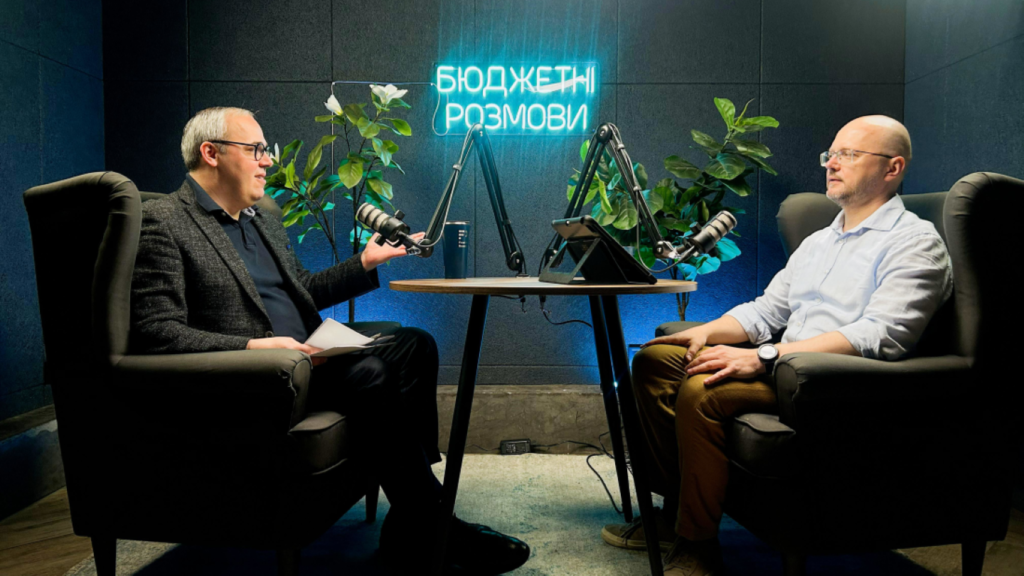
A special episode of Season III of “Budget Talks” – on Ukrainian business in wartime.
Why do Ukrainian entrepreneurs invest in new production facilities despite the risks? Can Ukraine reclaim its status as one of Europe’s textile industry hubs? And what must the state do to make that happen?
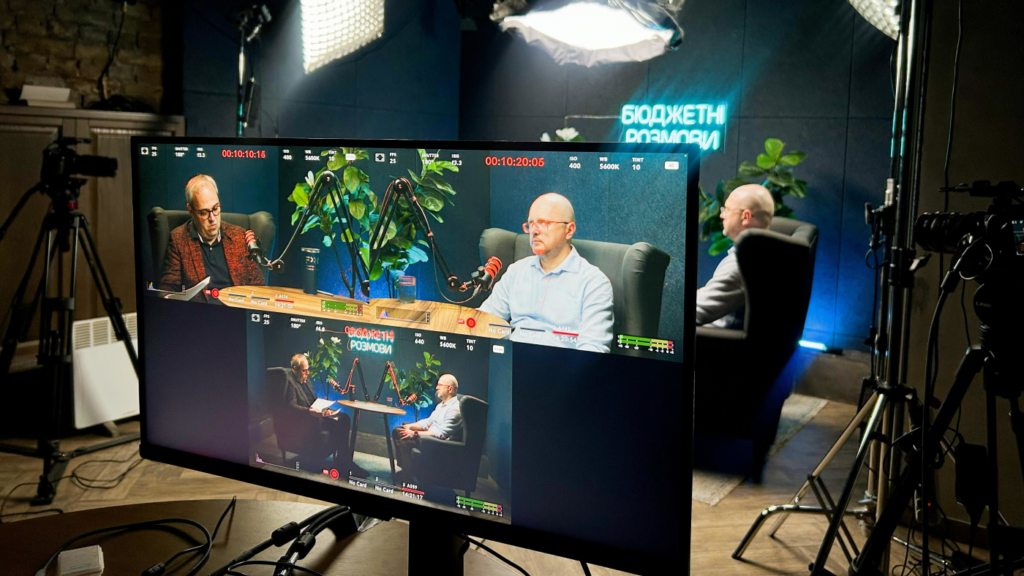
In this episode of the “Budget Talks” podcast, Viktor Mazyrchuk – Head of the Fiscal Policy Research Center – and Andrii Mykytiv – co-founder of Ma’Rijany Hemp – discuss the features and prospects of the hemp industry and the challenges facing Ukrainian producers today.
VIKTOR
Good afternoon! Welcome to a special episode of “Budget Talks,” where we talk about public finances – and in this case, not only about public finances, but also about business. Our guest today is Andrii Mykytiv, the head and CEO of a company called Ma’Rijany.
ANDRII
Co-founder.
VIKTOR
Co-founder. Glad to have you and thank you for joining us. I want to start with a small disclaimer: I personally have not received and will not receive any benefit from your company or any companies associated with you. Just so we are being fully transparent.
ANDRII
Thank you for the invitation. It is a real pleasure to be in this studio.
VIKTOR
Let me reveal a small secret: we have known each other for over 20 years.
ANDRII
Closer to 30.
On multimillion-dollar losses and relocation under shelling
ANDRII
We did estimate the losses. I can say that our direct losses currently stand at over one million dollars. The indirect losses are harder to quantify – the time we were at a standstill, the number of staff we unfortunately lost, the funds spent on relocating the business to a safer region. I can tell you that even today we are still covering certain costs that are a direct consequence of those events. Some of our staff were called up to the front. Not all of them were able to return. We support our employees who are serving, and we support the army as best we can. These are all costs that stem from what happened during those days.
VIKTOR
Did the state help you during the relocation? I recall that at the start of the invasion in 2022, there were various programmes for moving businesses to safer regions. You mentioned that you relocated to Kalush. Can you say more about your personal experience of that relocation and the state’s role in the process?
ANDRII
The support that was most relevant to us concerned the possibility of transport assistance – moving some of our equipment or materials to a new location. We applied, but were unable to use that support, because unfortunately our facility was in the epicentre of the fighting, in an industrial zone. No carrier, for safety reasons, was willing to go there and remove anything. So, our relocation was quite drawn out. First and foremost, that applied to our staff. We managed it with the help of our partner company, which gave us shelter – that was “Tarkett Vinisin”. We are very grateful to them for that shelter, and we are still there to this day. They provided us with an administrative building, which we converted into accommodation for our staff, and several dozen families were based there for an extended period.
VIKTOR
So, in practice, business was supporting business – because the state, given the security situation, was unable to help you?
ANDRII
That is one way to put it.
Why has the Zhytomyr region become the center of Ukraine’s new hemp production?
ANDRII
Several factors converged to determine that choice. We were looking for a fast start. At the time, we found common ground with Michel Tereshchenko, a well-known Ukrainian-French entrepreneur who had been growing hemp for a long time. We effectively joined forces with him and got the project off the ground at the site of a derelict facility that had stood idle for over 25 years with no signs of life. It was a base for a relatively quick launch of this project. Not that quick, mind you – it took us over three years to complete the initial phase and get the plant up and running. But by business standards, for a project of this complexity, that is still a fairly fast start.
The project then evolved and grew considerably. Not all of the shareholders – including Michel – were in a position to finance it at that scale. We bought out the stakes of those who could not continue, and carried on ourselves. But since a large portion of the capital had already been invested, we had to see the project through to completion. And we did. The plant is now operational.
Zhytomyr Region was one of the main – if not the main – flax-growing regions in Ukraine. Hemp was also grown there. It was a part of the country known for having at least 13 flax plants like ours – though probably smaller by today’s standards. In Zhytomyr there was the famous Zhytomyr Flax Plant, the largest facility in Europe for producing yarn and fabrics from natural fibre. Several attempts were made to revive it, but unfortunately all failed due to the absence of a raw materials base. That turned out to be the hardest part – far harder than we had initially estimated.
VIKTOR
What was the most difficult aspect?
ANDRII
We wanted to remain a fibre producer, but we also had to dive into agriculture – and then into seed production, and even seed breeding. As a result, today we have what is effectively an ecosystem combining the first five links in the production chain that will eventually become a textile product, a finished garment. We have now reached yarn, starting all the way from seed breeding, seed multiplication in cooperation with institutes across Ukraine, through the cultivation of the raw material itself – the stalk, professionally known as retted straw – and then the transformation of that retted straw into fibre.
VIKTOR
And do you plan to produce finished goods from the yarn?
ANDRII
This year we have only just started taking the first experimental steps into yarn. The road to finished goods is still very long. We are not even thinking about fabric yet. You can trade certain goods as a business, but becoming a manufacturer is a very different and challenging decision.
VIKTOR
But you have one eye on that direction.
ANDRII
Right now, I prefer to pursue partnerships. We have very good partnerships specifically in Zhytomyr Region – with the company “LESIA”, which produces finished goods including a wide range of products from natural raw materials. We are also developing a partnership with company “Edelvika” in Lutsk, which is a fabric manufacturer that has long worked with both flax and hemp. And we are of course open to deepening cooperation with other producers in Ukraine, since our entire textile industry was built on these two raw materials: flax and hemp. It was a supply chain in which we were self-sufficient.
Why is Ukrainian fiber exported right away?
VIKTOR
I understand why hemp – you were looking for a raw material source for your core business. And why Zhytomyr is clear, because it happened historically. But do you currently feel strong competition in Ukraine from the Chinese, the French? I am not talking about export potential, because I am not sure whether you currently export…
ANDRII
Unfortunately, there is not a single company in Ukraine that is able to consume our fibre. That supply chain was completely destroyed in the 1990s. So today our markets for fibre are exclusively export markets. There we do face some competition. The difficulty lies not so much in someone trying to sell cheaper than you, but in the fact that this product is in short supply – and equally in short supply are those who know how to work with it. That is the real challenge, one we unfortunately did not know about when we started this project. It is what makes the first steps so hard. And it is one of the reasons why so many such attempts have failed in the past. We hope we will not be part of that story.
VIKTOR
So alongside running your own business, you also have to develop the adjacent businesses that will consume your raw material?
ANDRII
I would say we need to make a massive educational effort – promoting this fibre in the market and demonstrating a reliable source of high-quality, consistent supply. Then manufacturers who know how to work with such fibre will turn it into yarn, and it will find its way to finished goods.
There are already examples of this today. We are in close contact with a whole range of such manufacturers. But of course, it is not easy to persuade the consumer – who is ultimately the one who pays for the product – to pay attention to ecological properties over price. Right now, natural fibres are more expensive than synthetic ones (with the exception of cotton, which is subsidised by every country in the world where it is grown). And convincing the consumer is not straightforward.
VIKTOR
You mentioned that international experience shows cotton is subsidised. Have you, as a raw material producer, received any benefits, subsidies, or any form of state support during the construction of the plant and the production of your goods?
ANDRII
When we were already building the plant, we decided to register the territory as an industrial park. The site is quite large. Under the current legislative framework, this opens up the possibility of importing new production equipment with a zero VAT rate, and also allows for a certain preferential period during which there is no profit tax. These benefits are available to all enterprises that become residents of any existing industrial park. So, it is less about direct financing and more about incentives.
In terms of direct state support, we do not receive any financial support – but we are invited to various platforms, including the Ukraine Recovery Conference [URC], which we have participated in over the past two years, where we can present our project to the world and attract potential investors if any appear on the horizon. It is a positive PR message that we are glad to receive, because it is the central external platform where Ukrainian businesses can showcase their capabilities.
VIKTOR
Prior to 2023, if I am not mistaken, the cultivation of hemp – including industrial hemp – was very tightly regulated; you needed to obtain a large number of permits. Can you explain what it was like before, what the state changed and why, and what the result has been?
ANDRII
To give the listener some context, we need to go back to the twentieth century, when humanity invented synthetic fibres and the first ideas emerged to make paper not from hemp – as was common at the time – but from timber. Because timber was already grown; you could simply cut it down and you had your raw material. Lobbying efforts meant that over the next few decades hemp was effectively pushed out of the economic supply chain. One of the fundamental steps was the inclusion of hemp in the list of narcotic substances in the 1961 Geneva Convention, which many countries did not join at the time. It took a long time before hemp was banned in Ukraine too. We joined this process in 2000. At the very moment when people around the world were beginning to think about liberalising hemp, Ukraine – “keeping in step with the times” – decided, forty years later, to join in and add hemp to the list of narcotic substances.
The legislation made no distinction between narcotic and non-narcotic hemp, even though Ukraine itself was the inventor of non-narcotic varieties. Unfortunately, the law was drafted in such a way that this distinction was difficult to detect. And the permit process was essentially a very complex exercise of proving and demonstrating that you were engaged in non-narcotic varieties. That was not the only reason, but it was one of the reasons why people stopped engaging in this crop. A farmer will sow buckwheat rather than hemp, because they do not need to prove anything to the Interior Ministry or the Ministry of Health, or go from office to office explaining what they do.
At the same time, the state continued to fund two institutes that were cultivating licensed varieties with no market for them – including the Hlukhiv Institute, which was funded for many years. This complex legislative landscape was simplified two years ago. Fairly strict regulatory measures were retained for medical cannabis – that is, cannabis containing psychotropic substances – but if you declare that you will be engaged in industrial hemp, you simply need to declare where you will do so, register those plots in the eHemp [digital industrial hemp registry], and at the time of harvest confirm – by testing in state laboratories – that it contains no narcotic substances. That is all. There is essentially no other regulation. In other words, the crop is now treated much like any other agricultural crop.
Why does hemp clothing still remain a luxury-segment product?
VIKTOR
Who is your biggest competitor in Ukraine and, possibly, abroad?
ANDRII
Since our products go to export, we do not face competition as such within the country. Our fibre is long fibre. We cannot process long fibre ourselves. We can only process fibre residues – that is, short and very short fibre, which serves as raw material.
VIKTOR
Let us explain where it is used.
ANDRII
If we are talking about long fibre, it is used to produce yarn and then fabric by the traditional method. It is the finest yarn available, but it is very expensive.
VIKTOR
“Traditional” – meaning the combing process?
ANDRII
Yes. It is called combed yarn. That is how all yarn used to be produced. The process is quite labour-intensive with low throughput, which is why this yarn is today represented very weakly compared to synthetic yarn or cotton yarn, which are produced in far greater volumes. A few figures to give a sense of scale. Last year, roughly 109 million tonnes of fibre were consumed globally; of that, approximately 67 million tonnes were synthetic fibres – predominantly PET, polyesters. Around 25 million tonnes was cotton. All plant-based fibres account for around 6 million tonnes. Hemp and flax together account for 300,000 tonnes of that, and of those 300,000 tonnes, long fibre is probably no more than 20%. There are reasons for that, as I have just described.
VIKTOR
Expensive?
ANDRII
Yes. If you want to buy hemp clothing, you head to the high-end branded stores: Lacoste, Louis Vuitton, Muji – that sort of brand. It is the finest clothing you can buy today, but it is far too expensive for the mass consumer. I believe, however, that we will break this negative trend. In particular, the company “Edelvika”, which I already mentioned, produces a range of hemp fabrics: bed linen, pyjamas, dresses, and vyshyvanky [traditional Ukrainian embroidered garments]. They have a good assortment. These are the people who are genuinely doing this today. After a trade show in Frankfurt at the end of April, we are seeing strong interest in these fibres. More buyers are already asking about fabric directly. And if you have yarn, fabric is not so far away.
VIKTOR
So, there is long fibre, which goes toward the products you described. And when it comes to short fibre – are those offcuts, residues, something like that?
ANDRII
During the combing process, shorter, weaker fibres are produced – they break and fall out, forming what is called a tow. There is also fibre produced through decortication…
VIKTOR
I have no idea what that means…
ANDRII
When you grow hemp for seed, the fibre is coarser and cannot be made into yarn, but it can be crushed to produce short fibre – similar to tow, but slightly coarser. The key factor is length. Short-length fibre can be turned into a non-woven material – for example, a thermal insulation mat that can replace mineral wool. You can handle it with your bare hands; it breathes; it is ecological. I noticed the acoustic panels in this studio. Ecological acoustic panels are a very popular trend right now in the acoustic insulation materials market. There are a number of companies worldwide offering hemp acoustic panels.
VIKTOR
I understand – there are all sorts of fillings that could be used.
ANDRII
Exactly. Fillings. Geotextiles for slope and bank reinforcement. We are currently in discussions with various companies around the world that work on shoreline reinforcement. They have come to realise that laying synthetic geotextile over the years has led to a massive build-up of microplastics in the water, and they are now actively switching to natural materials. That is where hemp comes in…
VIKTOR
…so, if I understand correctly, you work in a field connected to ecology, environmental sustainability, and protecting the planet?
ANDRII
Products derived from hemp are biodegradable – they are part of nature; the fibres are cellulosic and do not harm the environment. And that has been the case for thousands of years. You were asking about our name.
VIKTOR
Yes, please tell us.
ANDRII
Ryzhany – that is the village in Zhytomyr Region where we built our plant. As for “Ma” – hemp is the first plant (not second, not third – the first!) that humanity domesticated and began using among agricultural crops. Its history is ancient and stretches deep into human civilisation. The earliest finds of hemp products date to 8,000 BCE. They were discovered in south-western China and Taiwan. In those times, this crop was called by the word “ma.” And that is where the name comes from.
“We, as a business, are making a conscious decision to invest in Ukraine.”
VIKTOR
You are a wonderful example of the kind of business the state should love. An investor, building a plant, an industrial park, a new sector, development, jobs, plus ecology. Do you often receive high-level guests? I know that last year you had a delegation led by the then-Minister of Economy Yuliia Svyrydenko, now Prime Minister, along with Dmytro Kyselevsky, members of parliament, and government officials. Did you discuss the prospects for the industry? Second question – how many people do you employ?
ANDRII
Starting with the last question – we currently employ around 200 people. In terms of headcount, we are a fairly substantial enterprise. We have had just one visit of that level, the one you mentioned. Yes, Ms Svyrydenko did come – she is an admirer of traditional Ukrainian goods and vyshyvanky. This is a very interesting sector for the state right now. You could say the state is rediscovering how important this crop once was. I hope that will ultimately raise interest and, in time, lead to greater support and stimulation of cultivation specifically. Because cultivation is the main barrier to development. It is not an easy sector to rebuild. But I think the interest is there. We will keep reminding people about ourselves. We are looking for ways to get the state interested in promoting these products.
At present, hemp is not on the list of critical minerals and raw materials for Ukraine – even though, from a raw materials perspective, it is a critical input for Ukraine’s textile industry. I think that once there are serious efforts to develop Ukraine’s light industry – along the lines of what was once done in Turkey, for example, where the state for 20 years very intensively supported the sector through various investment development programmes, enabling Turkey to become one of the global leaders in textiles – all on the basis of cotton fibre – then things will change. In Ukraine, it is impossible to build a developed textile sector without a full-fledged domestic raw materials base. The principal raw materials are flax and hemp.
VIKTOR
What can the state do to help? Top 3 things you would ask of the state – or simply “stay out of the way, because your help will backfire”?
ANDRII
It is hard to name a Top 3 off the top of my head. What I would wish for: if there were state procurement orders – for hemp textile products, for example – that would be an effective way to support the market. There could also be measures previously directed at supporting farmers who grow this crop – some form of subsidy. If you grow hemp in Europe today, you can receive carbon credits, because every hectare of hemp sequesters between 9 and 15 tonnes of CO₂ through cultivation alone. Additionally, depending on the season, subsidies range from 90 to 140 euros per hectare of hemp grown. There is a hemp development and support programme on the European Commission website, which explains in detail just how excellent this crop is, how ecological it is, and how it benefits the environment. The third thing that comes to mind: in France, which is currently the leading hemp-growing country in Europe – with around 30,000 hectares currently under cultivation – whereas in Ukraine there was at one point 160,000 hectares…
VIKTOR
Back then.
ANDRII
Back then, yes. So, in France, this support takes the form of building codes that require all new construction to include ecological materials. As a result, hemp shives building products find their place in new eco-friendly homes. Or you can look at the project by OpenDoorUkraine.NL. They built a multi-storey hemp building in Switzerland – modern, energy-efficient, because hemp absorbs moisture and releases it depending on changes in external relative humidity. Heating and cooling costs drop significantly. In Ukraine there are a number of companies working in hemp construction, including Hempire. They have been long-standing advocates in this field. I asked the founder, Serhiy Boyko: “Serhiy, how do you sell your houses?” He said: “It’s quite simple. I just gather my winter utility bills, bring them to the client, show them – and you can be fairly sure that’s almost a sale right there.”
VIKTOR
So, in practice, you also need to advocate for support for the sector indirectly – through changes to building codes, for example?
ANDRII
Our government is trying to modernise the economy, find its strengths, and build a modern industrial base. From economics we know that the key to productive efficiency lies in productivity. Productivity means modern technology. If you as an investor plan to import or introduce advanced technological solutions, you need some form of incentive. If you are doing that – retooling, upgrading – those efforts deserve support. If we only invest in what already exists, that is a path to sustaining the status quo. But clearly, if we want something more, we need to bring in new technologies and move forward. We can see the state doing this in the defence sector – that is a priority, with intensive funding of inventions and innovations that deliver results on the battlefield. The same approach needs to apply to the rest of the economy: energy independence, distributed generation, a domestic raw materials base.
Textiles is a major sector – it accounts for a significant share of the human resources in any country’s economy. The economic miracle of some countries – South Korea, for example – is built precisely on a policy of state support for a range of sectors it identified as strategic: the defence industry, light industry, high-tech electronics (Samsung being the prime example). It is the role of the state to stimulate those sectors that lay the foundations for a country’s future development. And this raw material certainly does that.
We participated in a trade mission to the United States two years ago. When I was asked why we are doing this project in Ukraine, my answer was simple. If you look at it from the perspective of investment attractiveness, you have to honestly acknowledge that there are other countries where an investment project can be implemented more smoothly and with fewer risks – countries where there is no active fighting. We are doing this project in Ukraine because we want it to happen here. And that is a very important factor. I think the state sees that. It is not easy for us.
VIKTOR
Nearly five years of war. What are the biggest challenges you have faced as a business – and perhaps still face?
ANDRII
I think the personnel question is on everyone’s agenda right now as a serious problem. There are various dimensions to it. The level of compensation needs to be sufficiently high. Under wartime conditions, if you want to defer from military service 50 percent of your eligible employees, the average salary must be at least 2.5 times the regional average. That is a requirement that is not easy for any business to meet. There are also qualification-related issues: in wartime conditions, Ukraine has lost over 10 million people through emigration – people have left the country. And if we want to generate greater economic output, it is very hard to do that without personnel. So, retaining qualified workers and finding new ones is an extremely difficult challenge today.
The second thing that is a constant concern is military risk. It may not materialise directly, but you face its consequences every day – when there is no electricity. The impact on businesses of the destruction of our energy infrastructure is enormous. For any manufacturing project, it means the need for backup power sources: generators, alternative power supplies. I personally think that for the economy as a whole, distributed and alternative generation is a very positive development – far better, in my view, than sinking 10 billion dollars into two nuclear reactors that may not even be operational for another ten years. Solutions are needed now. And today, distributed generation is what can save our economic base. But it is a cost. It makes every investment more expensive. It makes things harder for business. Every production facility takes on additional costs. So, it is financially difficult. If you combine military risks with the electricity deficit – those are unambiguously large numbers.
VIKTOR
Anything else – or are just those two critical?
ANDRII
Off the top of my head those are the two I would highlight. I also like to draw on my macroeconomic background from time to time. Sometimes I think about the fact that our state budget is 100 billion dollars, half of which we receive from external financing. Those are not especially large numbers in absolute terms. Consider the scale of funds mobilised in 2019 by the European Union in a single year to address the COVID-19 crisis – 750 billion euros. My point is: if we want to incentivise businesses to locate in and open up in Ukraine, we should recall what all offshore zones started with. The success story of Cyprus in financial terms began with an environment of minimal taxes for businesses that registered there. Today, this is partially replicated in the case of industrial parks. But if we want a truly mass effect – to have people coming here to manufacture – we need to create conditions in Ukraine that can compete with the risks an investor takes when deciding to do so. We as a business are making a conscious decision to invest in Ukraine, because we want our country to survive – and we want to be one of the small stones that help it do so. But if you look at it from a purely economic and investment attractiveness standpoint, the factor of lower taxation is one of the things that can raise interest in locating any business in Ukraine.
Which global brands buy Ukrainian products?
VIKTOR
Andrii, tell me – do global brands purchase your products?
ANDRII
Global brands do buy, but they are global brands in the yarn market. The end consumer may be familiar with the brand that makes the final product. Our customer is the customer who manufactures yarn. And these are truly top-tier global companies.
VIKTOR
Which brands use this yarn of yours?
ANDRII
You would need to trace the supply chain to confirm it is specifically our yarn, but the well-known brands that currently produce clothing from hemp fabric include, for example, Lacoste, Levi’s, Wrangler, MUJI, Louis Vuitton. So, there are a number of well-known names in this space.
VIKTOR
And, to close – how do you see your business in ten years?
ANDRII
I am afraid that is a difficult question to answer. There are dreams. I dream that we will have consumers and clients in Ukraine. Of course, right now I am pursuing business development in external markets. But if the future were to change in such a way that we could sell a significant portion – if not 100% – of our output in Ukraine, I would be very glad. Because that would mean we had achieved one of our ambitious goals: we had revived the textile vertical we are currently working to build, and we had a self-sufficient supply chain in Ukraine. In that sense, the economist in me says that in times when globalisation is already becoming something of a distant memory, regional supply chains will come to dominate – and economic self-sufficiency will be an important factor in forming independent policy in the future, for any country, including ours. So that is something worth working towards.
VIKTOR
Thank you. And thank you to our defenders – men and women – for the opportunity to breathe freely in a free country.
ANDRII
It was a pleasure. Thank you.
VIKTOR
This podcast was created with the support of the Askold and Dyr Foundation, administered by ISAR Ednannia within the project “Strong Civil Society of Ukraine – a Driver of Reforms and Democracy,” funded by Norway and Sweden.
This podcast was produced by the Fiscal Policy Research Center with the support of the Askold and Dir Fund, administered by ISAR Ednannia within the framework of the project “Strong Civil Society of Ukraine – a Driver of Reforms and Democracy,” funded by Norway and Sweden. The content of this publication is the sole responsibility of the Fiscal Policy Research Center and does not necessarily reflect the views of the Governments of Norway or Sweden, or of ISAR Ednannia.